
- Version
- Download 3533
- File Size 0.00 KB
- File Count 1
- Create Date 16 May 2013
- Last Updated 5 September 2023
La Place du Mort. Les tombes vikings dans le paysage culturel islandais [The Place of the Dead. Viking Pagan Burial in Icelandic Cultural Landscape] (2013)
Adolf Friðriksson (2013) La Place du Mort. Les tombes vikings dans le paysage culturel islandais [The Place of the Dead. Viking Pagan Burial in Icelandic Cultural Landscape]. L'Université Paris-Sorbonne, Unpublished PhD thesis. 604 pp.
Abstract
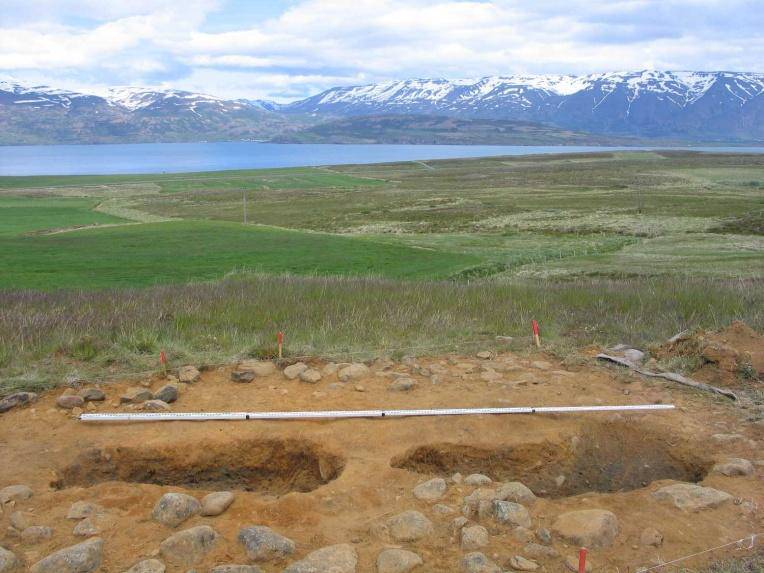
La place du mort is a topographical study of pagan burials from the late Iron Age in Iceland. The aim of this work is to investigate where burials are located, and explain the reason behind the choice of place. The results are based on a critical revision of all available data on known burial sites in Iceland, and a survey of each site in the field. The main results are presented as a model of burial location, which shows that graves were placed either a) away from farmhouses, on boundaries and by roads, or b) close to farms, and a short distance outside the main activity area of the farm, or c) at the crossroads between the main road and the home lane leading to the farm. These results were tested – and confirmed - by further field survey and excavation. When the details of each grave at the two extreme locations were compared, and interesting difference became apparent: At locations near farms, the graves are frequently orientated N-S, the grave-goods are in small numbers and of a limited variety, and the population are predominantly adult or old men. The graves far away from the farm, are most often oriented E-W, there is a greater number and a greater variety of gravegoods, and there are male and female graves of people of all ages. The differences between locations are explained as different stages of the process of the human colonisation of Iceland which occurred in the late 9th century : at the initial stage, burials were located near to the only significant place of the first settlers, the habitation. With growing immigration, people establish boundaries between farms by placing cemeteries there. Towards the end of the colonisation, where boundaries have been agreed upon, the most significant location shifts again, from boundaries, to the junction between the main road and the home track, leading to the farm which has been located between two already established settlements.
Alternative formats:
If you require this document in an alternative format, such as large print or a coloured background, please contact the author(s) or publisher. If it is a document authored by NABO, please contact us, either via our contact form or by emailing anthony.newton@ed.ac.uk.Related Posts

Share this: